A small business does not need a forty-page janitorial specification. It needs a short list of what happens every night, what happens every week, and what happens a few times a year, plus someone who actually does the monthly items instead of only the easy daily ones. If you run a storefront, a clinic, a studio or a ten-desk office anywhere in North Jersey, this is the working checklist, along with the two or three technical points that separate an office that is clean from an office that merely looks clean at eight in the morning.
The Nightly List
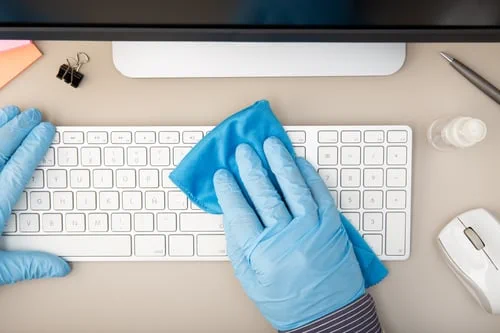
Daily work is about traffic and touch. Trash and recycling emptied with fresh liners, restrooms fully serviced and restocked, break room counters and sink cleared and wiped, entry glass cleaned at hand height where the smudges actually are, main traffic lanes vacuumed, hard floors spot-mopped. High-touch points get disinfected: door handles and push plates, light switches, shared appliance handles, the front desk counter. Reception goes first while the crew is still fresh, because it is the one room where a five-minute miss is visible to every client who walks through the door the next morning.
Restrooms deserve separate attention, since they are what customers quietly judge you on. The parts that get skipped are the underside of the seat, the flush handle, the base of the bowl where it meets the floor, and the joint between floor and wall behind the toilet. That joint is where odor lives, and no amount of air freshener covers it. An acidic bowl cleaner with a swab worked under the rim beats a squirt of all-purpose every time, and it takes about the same thirty seconds.
- Restock paper, soap and liners to a par level, not to whatever happens to be left
- Color-code cloths so restroom microfiber never touches a break room counter
Weekly and Monthly, Where Offices Slip
Weekly work reaches what daily work skips: full vacuuming including under desks and along wall edges, dusting of horizontal surfaces and monitor bases, interior glass and partitions, mopping all hard floors rather than just traffic lanes, disinfecting restroom partitions at hand height, and cleaning the microwave and refrigerator exterior. Monthly adds height and detail, meaning vents and diffusers, light fixtures, ceiling corners, blinds, window sills, chair bases and casters, walls around light switches, and a fridge clean-out under a stated purge policy so it is not one unlucky person's job to throw out somebody else's lunch.
The One Technical Thing Worth Knowing
Disinfectant only works if it stays wet. Every product label specifies a contact time, usually somewhere between one and ten minutes, and spraying a surface then immediately wiping it dry accomplishes very little beyond removing visible soil. Clean first to lift the dirt, then apply disinfectant and leave it alone. On a desk or a door handle that means a light spray and walking away, not spray-and-buff. This single habit is the difference between a real disinfection routine and a performance of one, and it costs no extra time when the crew works in the right order.
The other half of doing this properly is what gets scheduled a few times a year: carpet extraction, hard floor buffing or refinishing, upholstery on reception seating, interior windows, and a deep restroom tile and grout treatment. These are the items that protect the flooring and furniture you already paid for. Skip them for three years running and you have not saved money on cleaning, you have shortened a replacement cycle and moved the cost somewhere far less convenient.
North Jersey Specifics Worth Budgeting For
Storefronts on busy commercial streets in Jersey City, Union City, Paterson or Hackensack fight tracked-in road salt from December through March, and entry matting plus a neutralizing floor treatment will save your floor finish. If you lease a suite in a multi-tenant building, read the lease carefully: management usually covers lobbies, corridors and shared restrooms, but almost never the inside of your unit, and many buildings require a certificate of insurance and formal after-hours access for your own vendor. Sort alarm codes and key handling before the first visit rather than during it.
Match frequency to headcount and foot traffic rather than square footage alone, because a busy six-person clinic generates far more work than a quiet twenty-desk office. And ask whoever cleans your space to report low supplies and maintenance faults in writing the same night they see them, because over a year that log is worth almost as much as the cleaning. Scarlet Cleaning Services works with offices, clinics, studios and retail spaces across Hudson, Bergen, Essex, Union and Passaic Counties, schedules around business hours including nights and weekends, and provides free quotes with a written scope you can hold us to.